Description
Note: For pricing & ordering information, please contact us at sales@nanochemazone.com
Please contact us for quotes on Larger Quantities and customization. E-mail: contact@nanochemazone.com
Customization:
If you are planning to order large quantities for your industrial and academic needs, please note that customization of parameters (such as size, length, purity, functionalities, etc.) is available upon request.
NOTE:
Images, pictures, colors, particle sizes, purity, packing, descriptions, and specifications for the real and actual goods may differ. These are only used on the website for the purposes of reference, advertising, and portrayal. Please contact us via email at sales@nanochemazone.com or by phone at +1-780-612-4177 if you have any questions.
FAQs
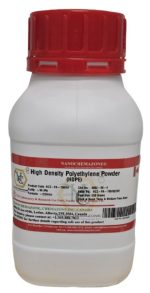
Q1: What is High-Density Polyethylene (HDPE) and where is it used?
High-Density Polyethylene (HDPE) is a thermoplastic polymer known for its high strength-to-density ratio. It is widely used in industrial products, packaging, films, pipes, containers, automotive parts, and consumer goods due to its excellent impact resistance, chemical stability, and durability.
Q2: What are the key properties of HDPE?
HDPE is characterized by high tensile strength, good abrasion resistance, low moisture absorption, and excellent resistance to chemicals and environmental stress cracking. These properties make it suitable for rigid and semi-rigid applications, delivering long-term performance in varied conditions.
Q3: Is HDPE suitable for extrusion, molding, and compounding?
Yes, HDPE is commonly used in extrusion, injection molding, blow molding, rotational molding, and polymer compounding. Its predictable thermal behavior and consistent melt flow properties allow for efficient processing and high-quality part production across industries.
Q4: What grades and particle forms are available for HDPE?
HDPE is available in various grades and particle forms, including powders and granules tailored for specific processing techniques such as rotational molding, masterbatch production, coatings, and compounding applications. Custom formulations can be provided based on specific industrial requirements.
Q5: How should HDPE be stored to maintain quality?
HDPE should be stored in a cool, dry, and dust-free environment, away from direct sunlight and extreme temperatures. Proper storage in sealed containers or packaging helps preserve its physical properties, prevent contamination, and ensure consistent performance during processing and use.